欢迎来到 [中博国际展览官网]
, 进入
2027宁波国际文具展
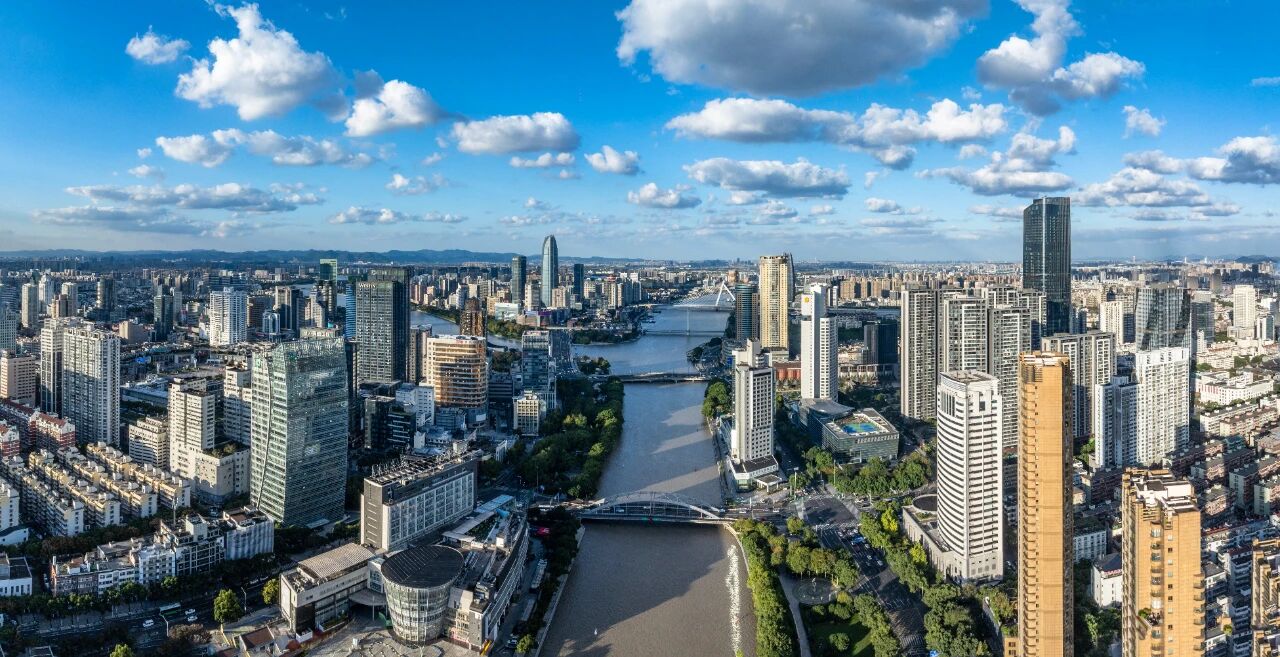
According to Ningbo Release, Ningbo Municipal Bureau of Statistics and the Ningbo Survey Team of the National Bureau of Statistics released the city’s economic performance for the first three quarters of 2026. Ningbo’s regional GDP reached RMB 1.4434 trillion, growing by 5.3% year-on-year at constant prices.
Based on the unified accounting of regional GDP across Zhejiang Province, the city’s GDP for the January–September period was RMB 1.4434 trillion, a 5.3% year-on-year increase at constant prices. By industry: the added value of the primary industry was RMB 31.1 billion, up 4.0%; the secondary industry RMB 621.6 billion, up 6.3%; the tertiary industry RMB 790.7 billion, up 4.6%. The ratio of the three industries was 2.1∶43.1∶54.8. Their respective contribution rates to GDP growth were 1.7%, 50.9% and 47.4%.
In the first three quarters, the added value of agriculture, forestry, animal husbandry and fisheries was RMB 32.5 billion, a year-on-year increase of 4.1%. The sown area of early rice reached 328,000 mu, up 9.3%; output of early rice was 127,000 tonnes, up 0.3%. Output of meat from pigs, cattle, sheep and poultry stood at 78,000 tonnes (+13.6%); milk output 3.6 thousand tonnes (+6.8%); poultry egg output 2.8 thousand tonnes (+6.4%); aquatic products output 807,000 tonnes (+5.6%). At the end of Q3, the stock of live pigs was 557,000 head (+1.9%), and breeding sows 64,000 head (+3.7%). Pig slaughter totalled 704,000 head in the first three quarters, up 6.7%.
The added value of industrial enterprises above designated size increased by 8.2% year-on-year. Among major sectors, nine out of the top ten industries by output value posted growth, jointly driving the growth by 7.2 percentage points. The added value of automobile manufacturing and computer, communications and other electronic equipment manufacturing rose 28.2% and 12.2% respectively, both achieving double-digit growth. By enterprise scale: large enterprises +11.7%, medium enterprises +3.1%, small enterprises +7.2%. Industrial sales value hit RMB 2.1247 trillion, up 11.1%, including export delivery value of RMB 338.9 billion (+4.2%) and domestic sales value of RMB 1.7859 trillion (+12.5%). For emerging industries, the added value of high-end equipment manufacturing, high-tech manufacturing and core digital economy manufacturing grew 14.2%, 10.3% and 9.7% respectively, all higher than the overall growth of above-scale industry.
The added value of the service sector increased by 4.6%, 0.2 percentage points higher than the first half of the year. The added value of information transmission, software and IT services; transportation, warehousing and postal services; accommodation and catering rose 8.1%, 7.6% and 7.6% respectively. The cargo throughput of Ningbo Zhoushan Port was 1.07 billion tonnes (-0.8%), of which Ningbo port area 530 million tonnes (-2.6%). Container throughput reached 34.66 million TEUs (+6.7%), including 30.62 million TEUs in Ningbo port area (+5.2%). At end-September, local and foreign currency deposits of financial institutions totalled RMB 4.33 trillion (+8.8%), and loans RMB 4.87 trillion (+6.9%).
Fixed-asset investment decreased by 6.7% year-on-year. Manufacturing investment grew 4.5%, accounting for 26.2% of total investment, 2.8 percentage points higher than the same period last year. Infrastructure investment rose 0.4%, with transport investment up 3.3%. Real estate development investment fell 18.7%. By industry: primary industry investment +17.8%, secondary industry +3.5%, tertiary industry -10.8%. Investment in core digital economy industries, equipment manufacturing and high-tech industries increased 38.6%, 15.4% and 15.1% respectively. Commercial housing sales area was 4.59 million square metres, down 12.4%.
Total retail sales of consumer goods reached RMB 422.3 billion (+2.3%), of which retail sales above designated size were RMB 167.8 billion (+1.1%). Basic consumer goods maintained steady growth. Retail sales of beverages, grain, oil and food, and daily necessities for above-quota units increased 11.5%, 9.8% and 5.9%. Some upgraded consumer goods saw rapid sales growth: retail sales of wearable smart devices and smartphones surged 160% and 120%. Online retail sales of above-quota units grew 15.5%, accounting for 41.7% of their total retail sales, 5 percentage points higher year-on-year.
Total foreign trade volume reached RMB 1.19 trillion, up 8.8%, 1.9 percentage points faster than the first half. Exports stood at RMB 822.3 billion (+11.3%), imports RMB 365.9 billion (+3.6%). Private enterprises remained the mainstay, with import and export volume of RMB 934 billion (+10.3%), accounting for 78.6% of the city’s total trade. Trade with the EU, ASEAN and the US rose 9.4%, 13.1% and 4.4% respectively. Trade with emerging markets such as Latin America and Africa increased 11.1% and 19.8%. Exports of the “New Three Items” grew strongly by 119.4%.
Residents’ per capita disposable income was RMB 65,073, up 5.0% in nominal terms and 3.7% in real terms after adjusting for price changes. Urban residents recorded per capita disposable income of RMB 71,422 (+4.5% nominal, +3.2% real); rural residents RMB 46,936 (+6.1% nominal, +4.7% real). By income source: per capita wage income RMB 33,160 (+3.8%); net business income RMB 11,766 (+3.9%); net property income RMB 7,254 (+4.6%); net transfer income RMB 12,893 (+9.4%).
The urban CPI rose 1.3% year-on-year. By category: food, tobacco, alcohol and catering +0.6%; clothing +1.8%; housing -0.1%; household goods and services +0.6%; transport and communication +2.1%; education, culture and entertainment +1.4%; healthcare +0.5%; other goods and services +14.2%. Within food and catering: aquatic products +2.8%, fresh fruits +2.0%, fresh vegetables +0.6%, pork -12.8%. In September, urban CPI increased 0.9% year-on-year and remained flat month-on-month.
The ex-factory price index (PPI for industrial producers) went up 2.7%, 1.1 percentage points higher than H1. It rose 6.3% year-on-year and 1.6% month-on-month in September. The purchasing price index of industrial producers increased 7.4%, 1.6 percentage points higher than H1; up 11.8% year-on-year and 2.1% month-on-month in September.
Overall, Ningbo’s economy maintained stable operation in the first three quarters. New productive forces are being nurtured and expanded, and tangible results have been achieved in high-quality development. Nevertheless, there are many unstable and uncertain external factors, domestic demand remains insufficient, and the foundation for economic recovery needs further consolidation. Going forward, Ningbo will follow the guidance of Xi Jinping Thought on Socialism with Chinese Characteristics for a New Era, pursue progress while maintaining stability, focus on improving quality and efficiency, fulfil the requirement of “better playing a leading and driving role”, steadfastly push forward project development, consolidate the industrial foundation, accelerate the expansion and upgrading of the service sector, continue to stabilise, expand, adjust and optimise foreign trade, shoulder the responsibility as a major economic city, and strive for a sound start to the 15th Five-Year Plan period.
Declaration: This article and photos are obtained from online platforms. Please contact us for removal should there be any copyright concerns.
 37
35
28
22
22
18
18
17
15
13
